
Custom Pole Barns in Central Florida
Custom pole barns designed for your specific use—built to last decades.
Pole barns offer cost-effective, versatile building solutions for property owners who need functional space without the expense of traditional construction. Whether you need agricultural storage, commercial workspace, or covered areas for equipment and vehicles, we build pole barns that stand up to Florida's challenging climate.

Buildings By Bill specializes in custom pole barn construction across Central Florida using post-frame building methods. We design and build pole barns for agricultural, commercial, and residential use—from equipment storage and workshops to covered arenas and commercial facilities. Each pole barn is custom-designed, built with quality materials by our in-house crew, and engineered to meet Florida's hurricane specifications.

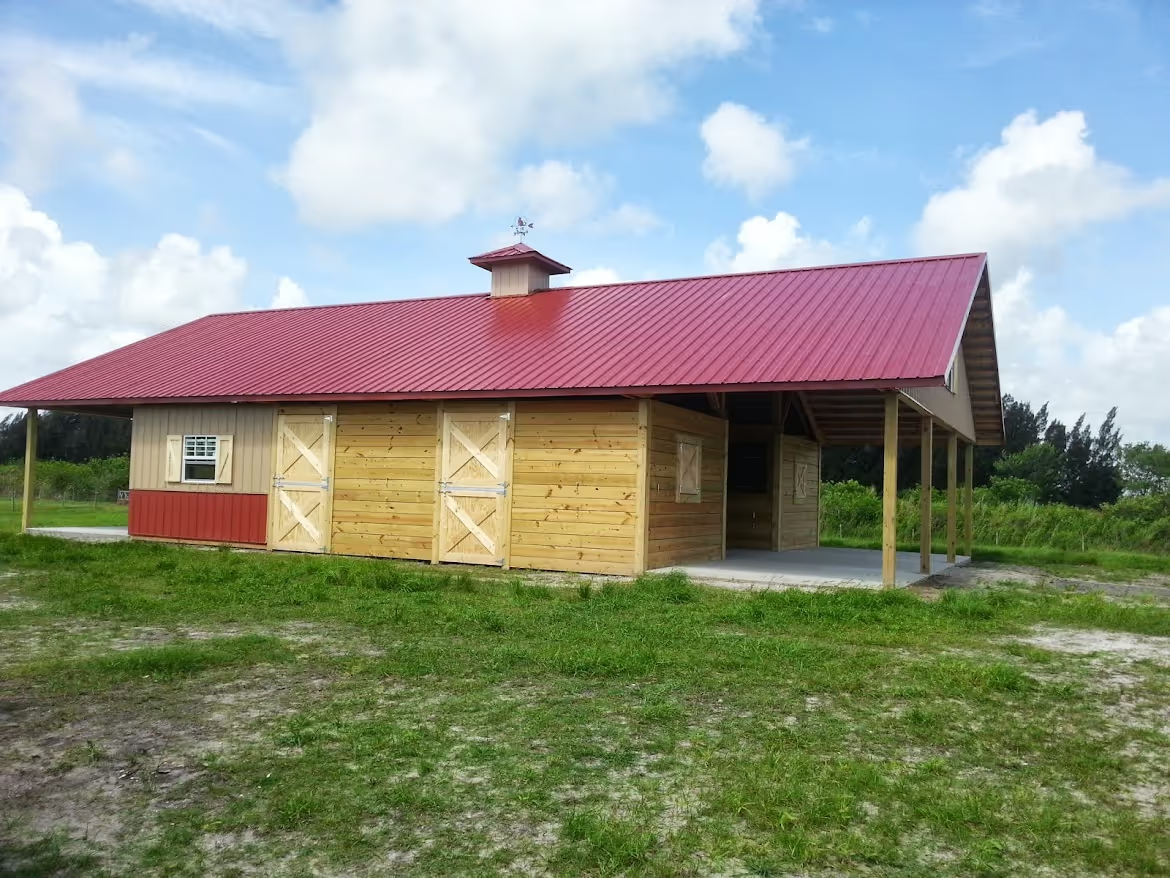
What Is a Pole Barn?
Pole barns, also called post-frame buildings, use large poles or posts buried in the ground or secured to concrete foundations as the primary structural support. This construction method offers several advantages:
Pole barns typically cost 40-60% less than traditional stick-frame buildings of similar size. The construction method requires less material and labor while providing excellent strength.
Without the need for interior load-bearing walls, pole barns can offer completely open interior space—perfect for equipment storage, workshops, or covered arenas.
Pole barn construction is faster than traditional methods. Most projects are completed in weeks rather than months.
Pole barns work for countless uses: agricultural storage, commercial workshops, retail spaces, covered riding arenas, equipment maintenance facilities, boat and RV storage, and more.
When properly engineered and built with quality materials, pole barns are extremely strong and can easily withstand Florida's hurricane winds.
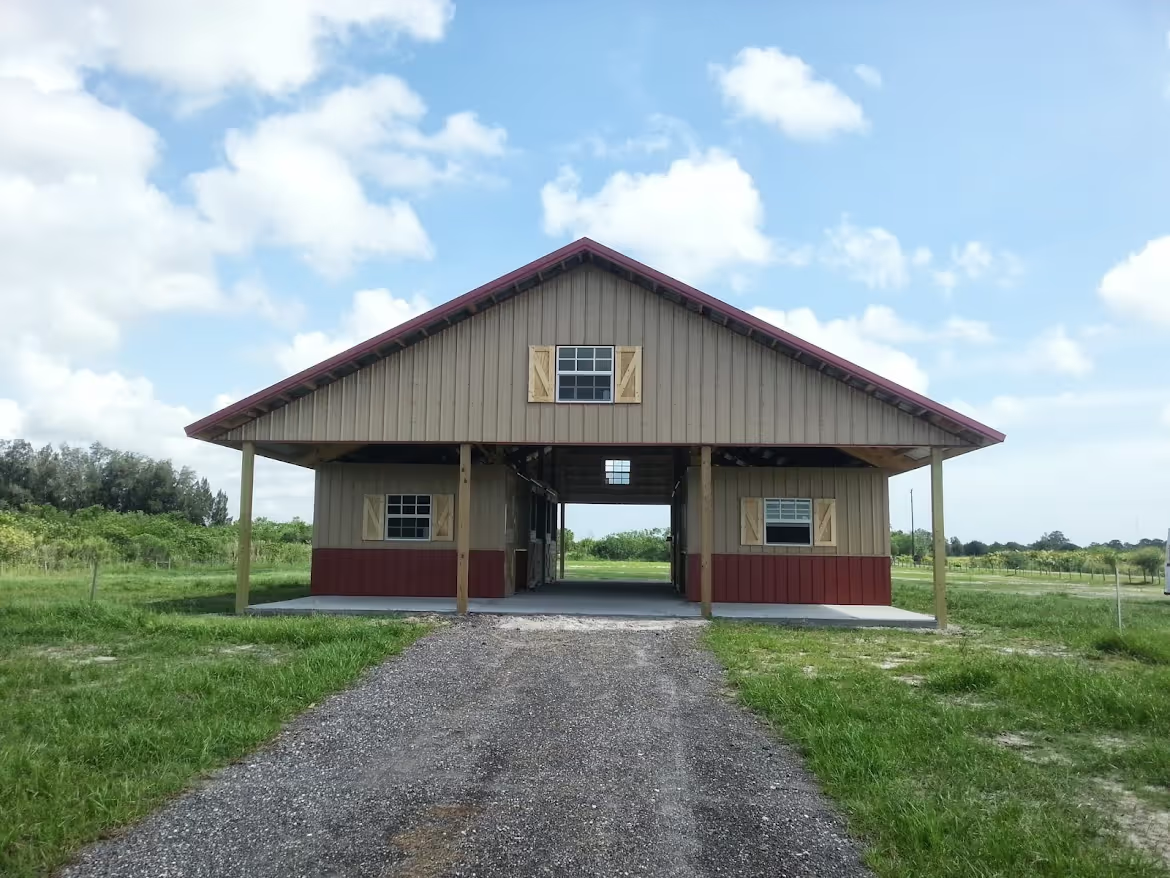
Why Choose Buildings By Bill for Your Pole Barn
35+ Years Building Pole Barns in Florida
I've been building pole barns across Central Florida since [year]. I understand what works in Florida's climate, soil conditions, and weather challenges.
After 35 years, I've built pole barns for every imaginable use—agricultural operations, commercial businesses, equipment storage, workshops, covered arenas, and residential applications. That experience means I can guide you toward the right design and avoid mistakes that cause problems later.
All In-House Construction
My crew handles all pole barn construction (except electrical work, which requires licensed specialists). No subcontractor coordination issues, no quality control problems, no scheduling headaches.
When you call years later with a question about your building, you're talking to people who actually built it.
Florida-Specific Engineering and Construction
Florida requires pole barns to be built differently than they are up north. Our challenging climate and hurricane risks demand proper engineering and quality construction.
Hurricane Wind Load Engineering- Every pole barn we build is engineered to meet or exceed Florida's hurricane specifications for your area. This includes:
Proper embedment depth or foundation design for poles
Adequate bracing and structural connections
Appropriate fastener schedules
Engineered for uplift and lateral forces
Metal roof and siding attachment to withstand high winds
Several of our customers have reported Buildings By Bill pole barns surviving hurricanes that destroyed cheaper structures nearby. That's what proper engineering looks like.
Florida Soil Conditions- Central Florida's sandy soil and high water tables require specific foundation approaches. We design pole embedment or concrete foundation systems appropriate for your site's soil conditions.
Humidity and Corrosion Resistance- We use treated poles, corrosion-resistant fasteners, and durable materials that stand up to Florida's humidity. Cheap hardware corrodes quickly in our climate—we use quality components that last.
Drainage and Site Preparation - Florida's heavy rains require proper site grading and drainage planning. We prepare sites to prevent water pooling and ensure long-term stability.
Quality Materials
The difference between a pole barn that lasts 15 years and one that lasts 40+ years comes down to materials and construction quality.
Poles/Posts:
Properly treated for ground contact and moisture resistance
Sized appropriately for your building dimensions and loads
Installed to correct depth or foundation specifications
Framing:
Quality lumber appropriate for spans and loads
Engineered trusses or rafters
Proper bracing and connections
Roofing:
Commercial-grade metal roofing
Proper fastening for hurricane winds
Adequate overhang for wall protection
Quality trim and flashing
Siding:
Metal siding (various profiles and colors)
Board and batten or other custom options
Proper installation and sealing
Doors:
Commercial-grade overhead doors
Quality personnel doors
Secure hardware and locks
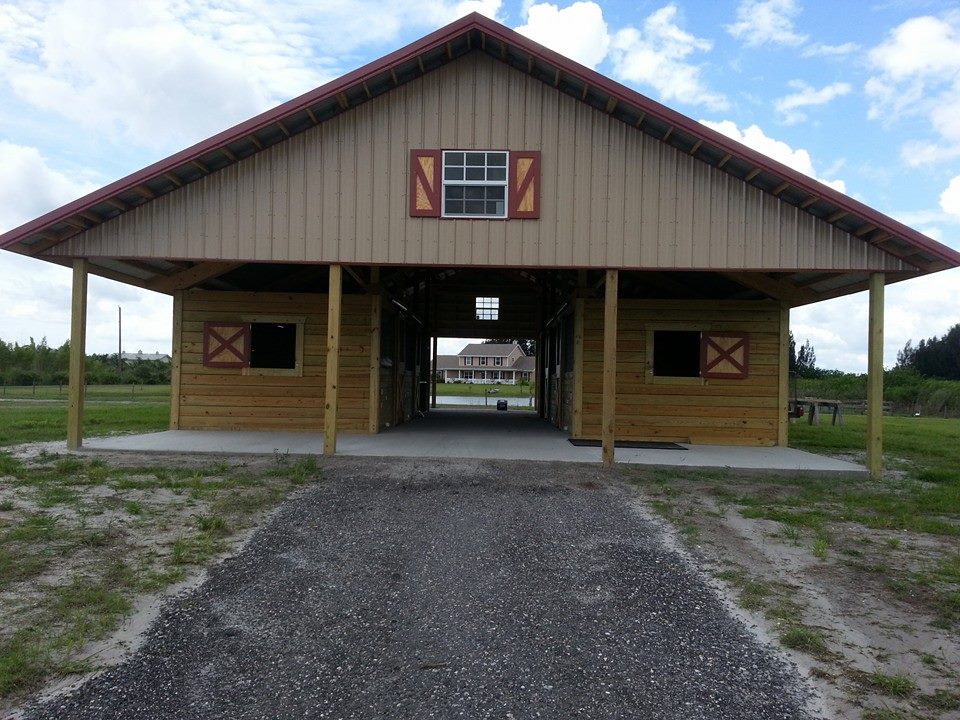
Pole Barn Applications
Agricultural Pole Barns
Equipment Storage: Store tractors, implements, and farm equipment protected from weather. Custom sizes to fit your specific machinery.
Hay and Feed Storage: Dry storage for hay, grain, and feed. Proper ventilation to prevent mold and moisture damage.
Livestock Shelter: Open or enclosed shelters for cattle, horses, goats, or other livestock. Custom configurations for your operation.
Agricultural Workshops: Maintenance and repair space for farm equipment. Adequate electrical for tools and welding equipment.
Commercial Pole Barns
Workshops and Manufacturing: Large open workspace for commercial operations. High ceilings for equipment, proper electrical, and climate control options.
Warehousing and Distribution: Cost-effective storage space for inventory and materials. Loading dock options and forklift accessibility.
Retail and Showroom: Affordable retail space with open floor plans and professional appearance. Customer-facing design options.
Service and Maintenance Facilities: Auto repair, equipment service, or maintenance operations. Multiple bay doors, concrete floors, and proper utilities.
Covered Work Areas: Protection from weather for outdoor operations, lumber yards, material storage, or equipment sales.
Residential Pole Barns
Large Garages: 4, 5, 6+ car garages built using pole barn methods for cost-effectiveness. RV and boat storage with high clearance.
Workshops and Hobby Shops: Dedicated space for woodworking, metalworking, automotive work, or other hobbies. Designed around your specific needs.
Equipment and Toy Storage: Protect ATVs, boats, RVs, trailers, and recreational equipment. Organized storage with room to work on equipment.
Covered Entertaining Areas: Pavilions, covered patios, or outdoor entertainment spaces with open-air designs or screened enclosures.
Equestrian Pole Barns
Covered Riding Arenas: Protection from sun and rain for training and riding. Various sizes up to 100'×200' or larger. Proper footing and drainage.
Hay and Tack Storage: Dry storage separate from horse barn living areas. Organized space for equipment and supplies.
Pole Barn Size Options
Small Pole Barns
20'×30' to 30'×40' (600-1,200 sq ft)
Perfect for:
Small equipment storage
Single-bay workshop
Residential storage
Small agricultural use
Medium Pole Barns
30'×50' to 40'×60' (1,500-2,400 sq ft)
Perfect for:
Multi-bay garages
Farm equipment storage
Small commercial operations
Workshop with storage
Large Pole Barns
40'×80' to 60'×100' (3,200-6,000 sq ft)
Perfect for:
Commercial operations
Large agricultural facilities
Multiple use areas
Vehicle storage and workshop
Extra-Large Pole Barns
60'×120' to 100'×200'+ (7,200-20,000+ sq ft)
Perfect for:
Covered riding arenas
Large commercial warehousing
Major agricultural operations
Manufacturing facilities
Custom sizes available for any need.
Design Features and Options
Structure Options
Roof Styles:
Gable roof (traditional)
Monitor or raised center roof
Lean-to additions
Various pitches
Open vs. Enclosed:
Fully enclosed
Open sides with roof coverage
Partially enclosed (some walls)
Three-sided structures
Interior Configuration:
Completely open
Partial walls for room separation
Mezzanine or loft storage
Office or retail space within structure
Doors and Access
Overhead Doors:
8'×8' to 16'×16' commercial doors
Multiple door placement
Insulated or non-insulated
Manual or motorized operation
Personnel Doors:
Walk-in access
Steel or wood construction
Multiple locations
Secure locking hardware
Large Access:
Sliding doors for wide openings
Bi-fold doors
Custom large access points
Electrical and Lighting
Overhead Doors:
8'×8' to 16'×16' commercial doors
Multiple door placement
Insulated or non-insulated
Manual or motorized operation
Personnel Doors:
Walk-in access
Steel or wood construction
Multiple locations
Secure locking hardware
Large Access:
Sliding doors for wide openings
Bi-fold doors
Custom large access points
Doors and Access
Overhead Doors:
8'×8' to 16'×16' commercial doors
Multiple door placement
Insulated or non-insulated
Manual or motorized operation
Personnel Doors:
Walk-in access
Steel or wood construction
Multiple locations
Secure locking hardware
Large Access:
Sliding doors for wide openings
Bi-fold doors
Custom large access points
Electrical and Lighting
We coordinate with licensed electricians for:
Basic or extensive electrical systems
220v circuits for equipment
High-bay lighting
Exterior security lighting
Multiple circuit panels
Three-phase power (if needed)
Concrete Floors
Full slab concrete
Partial concrete (work areas only)
Gravel or compacted base
Proper drainage and thickness for use
Reinforced for equipment weight
Climate Control
Insulation packages
HVAC installation coordination
Ceiling fans for air circulation
Ventilation systems
Heating options
Finishing Options
Exterior:
Metal siding (various colors and profiles)
Wainscoting or mixed materials
Custom trim and details
Professional appearance options
Interior:
Exposed structure (no interior finishing)
Liner panels for finished appearance
Drywall or shiplap (for office/retail areas)
Custom interior finishing based on use
Our Pole Barn Construction Process
Free Consultation
I'll visit your property to discuss your needs and assess your site. We'll talk about:
How you plan to use the pole barn
Size requirements
Site conditions and challenges
Access needs and door placement
Electrical requirements
Your budget and timeline
Custom Design & Engineering
I'll design a pole barn configured for your specific use. We'll:
Create a floor plan that works
Engineer the structure for Florida wind loads
Plan electrical and concrete needs
Specify materials and features
Provide detailed quote with line items
Permitting
We handle building permit applications and ensure your pole barn meets Florida building codes and local requirements.
Site Preparation
We prepare your site with:
Land clearing if necessary
Grading and drainage
Pole embedment or foundation work
Concrete pouring (if applicable)
Construction
My crew builds your pole barn:
Install poles/posts
Frame walls and roof
Install roofing
Install siding
Install doors
Coordinate electrical work
Final details and cleanup
Most pole barns are completed in 4-8 weeks depending on size and complexity.
Final Walkthrough
We walk through your completed pole barn together to ensure everything meets your expectations.
What Our Customers Say
Frequently Asked Questions
Pole barn costs vary based on size, features, and finishes. Basic enclosed pole barns (structure, roof, siding, doors) typically range from $20-$35 per square foot. Adding concrete floors, electrical, insulation, and finishing increases costs to $35-$60+ per square foot. A typical 30'×40' basic pole barn might cost $25,000-$45,000. I provide detailed quotes based on your specific needs.
Most pole barns take 6-10 weeks total including permitting (1-2 weeks), site prep, and construction. Small pole barns may be completed in 4-6 weeks. Large or complex pole barns may take 10-14 weeks. Weather can affect timelines.
Yes. We design and build all pole barns to meet Florida building codes including hurricane wind load specifications. All required permits and inspections are completed.
Absolutely, when properly engineered and built. We've had multiple customers report Buildings By Bill pole barns surviving direct hurricane hits with no damage while other structures failed. Proper engineering, quality materials, and correct construction methods make all the difference.
Yes. We can insulate walls and ceiling, which is recommended if you're climate-controlling the space or using it for temperature-sensitive operations.
Pole barns use post-frame construction with large poles as the primary structural support. This allows larger open spans without interior columns and is more cost-effective than traditional stick-frame construction. Both methods can be engineered for Florida's requirements.
Yes, in most cases. If you think you might expand, tell me during the design phase so we can build the initial structure to accommodate additions more easily.
Yes. We build pole barns for commercial operations including workshops, warehousing, retail space, and manufacturing facilities. Commercial buildings may have additional code requirements which we address during design.
Still have questions?
Serving Central Florida Property Owners
Based in Saint Cloud, we build custom pole barns throughout Central Florida:
Ocala, FL
Saint Cloud, FL
Gainesville, FL
Kissimmee, FL
St. Augustine, FL
Orlando, FL
Clermont, FL
Geneva, FL
And surrounding areas
Ready to Build Your Custom Pole Barn?
Let's discuss your pole barn needs. I offer free consultations where we talk about your intended use, visit your property, and provide honest advice about the right design and features.
Contact Information
Thank you for considering us for your Pole Barn needs. We will get back to you during normal business hours.